Sunday, April 10, 2011

Visiting Teaching Conference

For our Visiting Teaching Conference this year, we decided to do something light and fun. I found a cute "ant-themed" idea online at The Idea Door and tweeked it to meet our needs.

For the invitations, I envisioned red gingham for sure, but I could NOT find cute ant stamps anywhere in town...and I didn't have time to order new ones. I contacted two friends in my ward (congregation), who I know have just about every rubber stamp made under the sun, to see if they had any cute "picnic ant" stamps like this one I found here:
Kerry told me she had just a plain tiny ant stamp. I said "Perfect! I'll take it!" I was planning to pair it with a large fruit stamp anyway, and I knew just the one! I found this adorable watermelon stamp on clearance at Hobby Lobby. Using the two stamps together, I made these simple invitations:
And these envelopes:
Here's a closeup of the outside:
And the inside:
Once the invitations were done, I started having fun finding more "ant" and/or "watermelon" themed ideas. Look at these adorable cupcakes I found on this website:
I decided to skip the coconut and just use a "grass" icing tip. The fruit candy was ordered online here, but I had to add my own "seeds" with black icing.

I also found these cute giant ants at Hobby Lobby (they are actually salt and pepper shakers) and picked up three sets for our display table which included a red gingham tablecloth, picnic basket, etc.

For "handouts" we attached a cellophane bag full of chocolate covered raisins (ants) to the poem and calendar found here and placed them in this cute picnic basket:

Here's our program:

RELIEF SOCIETY PRESIDENT - Welcome to our Visiting Teaching Conference. We are so grateful to have all of you here today. This is an annual event for all the sisters in our entire Relief Society. For the past couple of years, we have made an effort to present a very spiritual program...blah, blah, blah

(INTERRUPTED BY ANTS)

Seven "ANTS" enter the room marching and singing. They’re wearing all black clothing and black antennas. They march to the front and sit down holding their poster board sign. (For the seven ants, we used the remaining members of our RS Presidency and our Visiting Teaching Supervisors.)

SONG; SUNG TO THE TUNE OF “THE ANTS GO MARCHING"

The Ants go marching two by two horrah, horrah

The Ants go marching two by two horrah, horrah

The Ants go marching two by two ‘cause that’s what Visiting Teachers do.

And we all go marching out, to the homes, of the sisters, that we love

Boom boom boom boom boom boom boom boom

The ants go marching two by two horrah, horrah…

(repeat as long as needed then fade out)
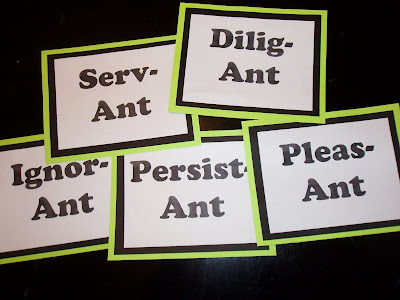
This is a photo of some of our "ANT" signs. I just printed them on standard 8 1/2 x 11 paper from the computer and then glue-sticked them to card stock. We glued the song lyrics, speaking parts, and quotes to the back just in case we needed reminders.

Story told by Relief Society President:

There once was a community of ants, and within that community was an LDS ward of ants, and within that ward, was a RELIEF SOCIETY of ants, and in that Relief Society were seven sister ants named:

1. “Persist-Ant” (Persist-Ant stands up, holds her sign and says “I never give up!”)

2 “Observ-Ant” (Observ-Ant stands, holds up her sign and says “ I always notice what my sisters need.”)

3. “Pleas-Ant” (Pleas-Ant stands up, holds her sign and says “I just love Visiting Teaching. I so enjoy being around the other sisters!”

4. “Dilig-Ant” (Dilig-Ant stands up, holds her sign and says, “I take my assignment very seriously. I read the lesson on the first of every month so I have lots of time to ponder it. I also have a standing appointment with my sisters.”

5. “Obedi-Ant” (Obedi-Ant stands up, holds her sign and says, “We just do our Visiting Teaching every month no matter what because that’s what we’re supposed to do.”

6 “Serv-Ant.” (Serv-Ant stands up, holds her sign and says, “I love to serve the women in the ward. Christ said, ‘When ye have done it unto the least of these…ye have done it unto me. There is nothing I wouldn’t do for my Savior.”

7. “Ignor-Ant” (Ignor-Ant just sits there clueless in a daydream.) Relief Society President repeats, “IGNOR ANT!” “What?

Every month the sister ants would march out of their ant hill two by two to go to Visiting Teaching. You could always tell who was who even though they looked very much alike. (Each ant stands and acts her part in turn.)

Persist-Ant was always the first to get her visiting teaching done. She wasn’t easily discouraged when plans fell through. She would reschedule, send a note, make a phone call, or even drop by with a home baked treat just so her sister’s knew they were loved. Persist Ant never gave up on her sisters, even if they weren’t easy to get in touch with.

Observ-Ant was very aware of the needs of her sisters. She could tell when they needed an extra hug or phone call. She noticed when they weren’t at church and always let them know that they were missed. Observ-ant noticed details and it enabled her to better love those she served.

Pleas-Ant was easy to pick out. She always wore a big bright smile. Everybody knew and liked Pleas Ant because she was so fun to be around. Her sisters looked forward to her visits because they knew how pleasant she was…always leaving them in a better mood.

Dilig-Ant was so effective in her assignment., she worked harder than anyone! She was so diligent that she not only read the Visiting Teaching message, she would read the whole Ensign. No matter what assignment she was given, she always did a good job.

Obedi-Ant lived the gospel. She was a wonderful example because she applied the gospel teachings and actually practiced what she preached. Her example of obedience was an inspiration to the sisters she visited.

Serv-Ant was often quiet but always doing something for others. She would help with housework, offer rides to the doctor, volunteer to watch little ones, read to the elderly, and more. Serv-Ant never wanted to be thanked or repaid for anything she did. She truly enjoyed serving others. When others would ask why she was so happy, she told them it was because helping others made her happy.

Finally, there was ignorant. She didn’t have a clue. “What?”

Sisters, this is just a cute fictional story. Even so, I’m sure we each see a little bit of ourselves in every one of these examples. I want to complim-ANT all of you who are already doing an excell-ANT job in your assignm-ANT. Please remember that as a Visiting Teacher, you are "Import-Ant' (hold up sign). Today, you may want to ask yourself which kind of ANT are you. Maybe you are a combination of several of these. Most importantly, what kind of ANT do you want to BECOME?

VISITING TEACHING COORDINATOR:

(Each ant stands as her name and description are given. Then she reads her quote.)

Persist Ant

How many of us have tried many times to reach a sister or to find her at home and then given up when they haven’t been successful a few times? Pray with your companion. Keep making appoints and keep them. Invite the sisters to Relief Society meetings and activities.

“Elder Bruce R. McConkie has so eloquently taught us that service is essential to salvation. I have been impressed with the urgency of doing. Knowing is not enough; we must apply. Being willing is not enough; we must do. Progress is not created by contented people. It is up to us, you and me, to be uncomfortable in complacency, to refrain from being spectators, and to be players in the game of life. The Lord has chosen His people to perform a mighty work. Our home teaching, our visiting teaching should be more than going; it should be doing with Christian love. It can be done; you can each do your portion of the work because you desire it.” Elder Russell C. Taylor, The Joy of Service, General Conference, October 1984

Observ Ant

We can observe the good in people. We need to look for the best in the sisters we visit teach. We need to see beyond the physical and try to understand her heart. Report any concerns to the Relief Society President.

"It is the individual who is not interested in his fellow men who has the greatest difficulty in life and provides the greatest injury to others. It is from such individuals that all human failures spring." -- Alfred Adler

Pleas Ant

We need to visit teach with the right attitude. It should be an experience we look forward to. Put on a smile when you go to a sister’s home! Remember her birthday and other important events in her life.

"To be successful, it seems to me that a visiting teacher would wish to have high purpose and remember it all the time, would want to have great vision, a terrific enthusiasm that cannot be worn down, a positive attitude, of course, and a great love. . ." Teachings of Spencer W. Kimball page 525

Dilig Ant

As Visiting Teachers we need to fulfill our callings to the best of our abilities. Be sure to give a message each month. We need to get to know the sisters we teach and say hello to them when we see them, sit by them in church and be their friends, not just be a once a month visitor.

“The first-line support to the families in the Church organization is priesthood home teaching and Relief Society visiting teaching. These functions provide two important services. They keep the bishop, the quorum leader, and the Relief Society president adequately informed of the physical, emotional, temporal, and spiritual condition of the membership. They also have teaching opportunities and serve as a resource to provide some of the training to the families as they prepare for self-sufficiency.” Elder L. Tom Perry, The Need to Teach Personal and Family Preparedness, General Conference, April 1981

Obedi Ant

President Brigham Young "All the sacrifice that the Lord asks of his people is strict obedience to our own covenants. Blessed are they who obey when the Lord gives a direct commandment, but more blessed are they who obey without a direct commandment. Do your visiting teaching and report your visits to your district leader.

"I hope that home teachers and visiting teachers will experience two things: first, the challenge of the responsibility that is in their great calling, and second, the sweetness of results from their work, particularly with those among us who are less active. I hope that these teachers will get on their knees and pray for direction, and then go to work to bring these wandering prodigals back into the fold of the Church. If home and visiting teachers respond to this challenge, I honestly believe that they will taste the sweet and wonderful feeling which comes of being an instrument in the hands of the Lord in leading someone back into activity in His church and kingdom.

"I am making a plea for us to reach out to our brethren and sisters who have known the beauty and the wonder of this restored gospel for a brief season and then for some reason have left it.

"May all home teachers recognize that they have an inescapable responsibility to go into the homes of the people and teach them to live the gospel principles more faithfully, to see that there is no iniquity or backbiting or evil speaking, to build faith, to see that the families are getting along temporally. That is a very serious responsibility; it really is. But it is not a heavy burden—it just takes a little more faith. It is worthy of our very best effort." (Instruments of the Lord," Ensign, March 1997.)

Serv Ant

When ye are in the service of your fellow being ye are in the service of your God. We need to go the extra mile when the need arises. Cook a meal, take her children for an afternoon, give comfort when needed. There are so many ways to serve.

Opportunities to lose oneself for the good of others present themselves daily:… visiting teaching; time for compassionate service; giving comfort to those who need strength; serving with diligence in Church callings;… Truly, the day of sacrifice is not past.” President Ezra Taft Benson, This Is A Day Of Sacrifice, General Conference, April 1979

Ignore Ant

Finally, understand your duties as a visiting teacher. If you have questions, lds.org is a great place to turn. You also have a Visiting Teaching supervisor, Visiting Teaching Coordinator, and Relief Society President to turn to. They all want you to succeed

I don’t know what’s going on.

Discussion:

We decided to spend the last ten minutes or so as a question/answer period. Here are some of our discussion questions:

1. Is it ever okay to be released from a Visiting Teaching assignment or partnership?

2. Do I always need to bring a gift to my sisters when I visit? What are some thoughtful, inexpensive ideas?

3. How important is it that we share the lesson every month?

4. Should we begin and end our visit with prayer?

5. What if I can't go during the day or night when it's best for one of my sisters?

6. Is it okay to bring young children?

7. How long should we stay?

8. What if my partner can't go?

9. What should I bring?

10. What constitutes a visit? When is it okay to send a letter, e-mail, or phone call?

11. How do I report my Visiting Teaching?

12. What should I do if my partner dominates the entire visit and only talks about herself?

Have fun planning your Visiting Teaching Conference! Feel free to e-mail your ideas to me for posting on this blog at colleendrake@gmail. Thanks for visiting!

Friday, April 8, 2011

Today & Tomorrow


Today was monumental because I baked 65 cupcakes for the Visiting Teaching Conference on Sunday...and I only burned 12 of them. That definitely earns my stamp! Tomorrow will be monumental because I will ice and decorate all of them. :)

Thursday, April 7, 2011

Put a STAMP on it!

So, I went walking this morning with Kira Feik.
She's an amazing woman who always has a great story to tell, and I'm really enjoying getting to know her.
Among other things we chatted about, while I was gasping for breath to keep up with her,
was her need/desire to do something "monumental" every day--to do one thing that sort of defines the day--one thing that gives it meaning and gives her a feeling of accomplishment.
She likes to be busy (so do I). She told me that she wants to be able to "put a stamp" on each day--a stamp that says, "Today made a difference because..." "Today was about THIS!"

At the end of our walk as we arrived at her car, I said "Have a great day!" and she responded with,
"Make it a STAMP day!"
I like to be productive. It's pretty much against my nature to be idle; but I hadn't really thought of it this way before.

I LIKE it!

I'm going to focus on making sure every day has a little monument--a stamp of something notable that was accomplished. Sheeesh, sometimes it's a monumental event if I just make dinner!

Yesterday's "stamp" was making fleece blankets for disaster victims in Japan.
Hmmmm....What will today's stamp be?

Ten Tips for Helping Kids Memorize

Many of us underestimate our children's ability to memorize. Those little sponges absorb and retain a phenomenal amount of information.
Once when my son, Daniel, was about three years old, I promised him we could bake chocolate chip cookies together. He was so anxious and excited about it, he could hardly wait. I was busy with his little sister, and when I finally made it to the kitchen, I saw that he had carefully placed on the counter every ingredient we would need plus a mixing bowl, measuring cups, and measuring spoons. I couldn't believe it! He was THREE! He couldn't possibly read a recipe, but he had seen me bake cookies before, and he memorized all the ingredients...from the brown and white sugars down to the baking soda and vanilla. He even knew how many eggs we needed!
I shouldn't have been so surprised. The same kid could rattle off every line in the movie "Toy Story" and name every Star Wars figure known to man. Our children's little minds are truly amazing! This experience reinforced to me that I really should be capitalizing on the opportunity to teach them while they're young and even help them commit to memory valuable information. From poems to scriptures to multiplication tables, children who can memorize are miles ahead of those that never learn how.
Here are some tips/methods for helping your kids memorize:

1. Put it to Music - Children can hear a silly rhyme or song once and sing it again days later. Something about the rhythm, rhyme, and melody helps it stick. Think about it. How do we teach them their ABC's? We sing them. Whatever you want your children to learn, your chances are increased significantly if you put it to music. Forth graders are able to memorize all fifty states...IN ORDER...in just a couple of days by learning a catchy tune. My youngest used to sing at the top of her lungs every time she was sitting on the potty (something about the echo in the bathroom, I guess). What did she sing? The days of the week. Thanks to a big purple dinosaur named Barney, she had them memorized as a two-year-old because they were set to music.

2. Echo - Slip on a "magic" glove (any ole' glove will do). When it points to mom, it's her turn; when it points to the child, it's his turn. Recite just a few words at a time and then have the child repeat (echo) what you say. Add on one or two more words each time.

3. Recite in Different Voices - This is a fun way to increase repetition while minimizing boredom. Have the kids recite it in baby talk, in a British accent, in an army sergeant's command, in an opera singer's voice, in a whisper, in a fast-speed chipmunk voice, in a robot voice, in a Donald Duck voice, country western style, etc. You get the idea. Be creative and have fun with it.

4. Erase It - For children who can read, write out the entire verse on a dry-erase board or chalkboard. Have them read it aloud and then chose one word to erase. Read aloud again (including the missing word) and choose a second word to erase. Continue to repeat. Eventually, the entire verse will be erased and they will recite it on their own.

5. Create an Acronym - Instead of writing out the entire verse, just give them the first letter of each word as sort of a "cheat sheet". For example, if they were memorizing The Pledge of Allegience, you would write "I P A T T F O T U S O A..." I often use this tool with "Erase It"...works great for adults too!

6. Review Often-If you don't use it, you lose it. Review especially right before bedtime. I once read that we should pay close attention to what enters our child's mind right before sleep. Whatever a child hears, sees, or experiences immediately before dozing off sticks with them throughout the night. Knowing this, I would much rather have a poem about honesty or obedience in their impressionable little minds than the nightmare of mom screaming at them to get into bed--just another valuable tidbit of information that I found very useful.

7. Create an Acrostic - What the heck is an acrostic? I've used them many times, but didn't know they had a name. Lists can be challenging to learn, especially in the right order. For example, the seventh Article of Faith lists: "tongues, prophecy, visions, healing, interpretation of tongues...." When my oldest was memorizing this we both had trouble getting them in order. I suggested that he come up with a sentence made of words that started with the same letters (TPVHI). I have to admit, every time I recite the 7th Article of Faith now, I think of his boyish sentence and it puts a smile on my face. Ready for this? "Toilet Paper Very Helpful Indeed!" That was his acrostic! Whatever it takes, right? Many school age children learn the planets in order the same way. Mercury, Venus, Earth, Mars, Jupiter, Saturn, Uranus, Neptune, Pluto ="My Very Energetic Mom Just Served Us Nine Pizzas." Cool tool, huh?

8. Break it up - When your kids are memorizing anything of significant length, it's always helpful to divide it into manageable pieces. This is especially useful with long lists of numbers. One school teacher used this method for helping young children memorize their phone number quickly. First she talked about their having a first, middle, and last name. She had them each write down their three names. Then she explained that their phone number had a first, middle, and last name. What's your phone number's first name? (213) What's your phone number's middle name? (398) What's your phone number's last name (7682). What's your phone number's name? 213-398-7682. Memorizing ten digits in a row may be too challenging, but three smaller sets of numbers is not.

9. Use more Senses - The more senses your child uses, the more engaged her brain is and the stronger the imprint left on her memory. It has been said that we only retain a small percentage of what we hear, we remember a greater percentage of what we hear and see, and an even larger percentage of what we hear, see, and do. When helping children memorize, it's useful to add visual aids and/or actions. American sign language or other simple hand gestures assist with the memory process. So, make some flashcards or a poster; better yet, have your child help make them. If you want your child to do well on a spelling test, in addition to having her look at the words, and spell the words aloud, have her write the words repeatedly. It's not just "busy work". The more senses she uses, the more she'll remember.

10. Repetition - Quote the poem, verse, or article over and over. Repetition can be extremely helpful in learning patterns. Did you know that in the past few years, learning by repetition has been associated with forming the connection of synapses in brain cells? Basically, this helps with not only learning the information in the first place, but also in recalling it throughout the life of the child. Once the information has been memorized using repetition, the information is more easily recalled in the future. That must be why I still remember all the poems I memorized in elementary school. Repeat, repeat, repeat!

I hope these tips are helpful to you and your children. They've certainly worked for me and mine. :)

Wednesday, April 6, 2011

Children, Repentance, and Oranges

Several years ago, my six year old came to me with a look on his face that we all would recognize as a little boy who had just done something he shouldn't. He held out three quarters in his hand and peered up at me--couldn't even lift his head because of the shame he felt. He didn't say anything, so my inquiry began:

"David, where did you get those quarters?"

"I found 'em."

"You lucky boy! Where did you find them?"

"On the sidewalk."

"On the sidewalk in front of whose house?"

"Just on the sidewalk...(sigh)...okaaaay, I found them in front of Laff's house."

"Well, we better go talk to Laff then and see if they belong to him, don't you think?"

"(Bigger sigh)...Okaaaaay, I found them on Laff's porch."

"Well", I thought, "now we are getting somewhere."

Using my very best parenting skills, and as lovingly as I could, I expressed my appreciation for his honesty. I explained that we NEVER take things from others without asking. I suggested that he return the money and apologize so that he could feel better inside. So, after some coaxing, we walked across the street together and I stood beside him on the porch like a reassuring mother should, giving him encouragement to do the right thing. As we were walking home afterwards, I sensed some relief in my little boy's disposition.

Boy...was I fooled!

Evidently, his entire confession was a fib. He and his five-year-old sister had gone TWO BLOCKS out of their boundaries, stolen ORANGES off of a neighbor's tree, and SOLD them for two dollars and twenty five cents! All but the last three quarters had already made it into his bank.
So, on Sunday afternoon, we took a family walk to ANOTHER porch and went through a similar situation in attempt to make restitution. Because we told them to, the kids apologized to the neighbor for taking oranges without asking and promised not to do it again.

I came home feeling extremely inadequate at my endeavors to teach my children the meaning of true repentance. The thought of my kids growing into juvenile delinquents locked behind bars with orange pulp on their faces haunted me. I felt a tremendous responsibility and wondered if I could possibly prepare them to become honest, law-abiding adults.

At that very moment, the phone rang. It was a member of the Stake Presidency asking me to speak in the upcoming Stake Conference. (For those of you who are not members of my church, Stake Conference is a semi-annual meeting where approximately 500-700 people are in the congregation. No biggie.) My assigned subject?..."TEACHING CHILDREN THE PRINCIPLES OF REPENTANCE, FORGIVENESS, AND LOVE". Do you get the idea that our Heavenly Father knows us personally?

Then, if it wasn't miraculous enough that I was asked to speak on the very subject that consumed my thoughts at the moment, he explained that I would be speaking with a General Authority. "Have you ever heard of C. Max Caldwell", he asked? "Yes, as a matter of fact, I have. That great man was my mission president ten years ago. I have a deep love and respect for him. No one has taught me more on these very principles than he has."
I felt tremendous comfort knowing without a doubt that my Heavenly Father was very aware of the details of my life. He loved me, and He knew how to communicate it in a way that I would recognize with complete certainty, exactly when I needed it. I felt like He was saying, "Colleen, you ARE doing a good job. Keep trying, and I will bless your efforts." I recognize and am grateful for the tender mercies of the Lord in my life. He is a concerned, involved, loving Father and I am His daughter. That's the most important thing I know.

Tuesday, April 5, 2011

Helping Your Children Achieve Their Goals

Reaching our goals gives us a great feeling of accomplishment, builds our self confidence, and drives us towards more progress and growth. Learning to set and achieve goals can and should begin very young. How young? Easily by three years of age. What kind of goal could a three-year-old possibly have? Well, if you've ever raised a child, you might understand that any of these could be possibilities:

1. Stay in my bed all night.
2. Keep my panties dry all day.
3. Wipe myself when I go potty.
4. Eat all my vegetables at meal time.
5. Pick up my toys every day.

I had a two-year-old say to me the other day with great excitement, "Ms. Colleen, I sleeped ALL NIGHT!" She was so proud of her accomplishment. More so, I think, than she was about the sparkly sticker mom and dad gave her in the morning.
For a five-year old, the goal may be:

1. Tie my own shoes.
2. Read a book aloud each night.
3. Make my bed every day before breakfast.
4. Use good manners at the dinner table.
5. Put away my clean laundry without being asked.
Professionals say it takes approximately 21 days to develop a new habit (seven days to break one). So, we can't expect a child to conquer any of these overnight. It's a process. The best thing we can do is to encourage them, give them incentive, and help them (and ourselves) visualize their progress. A few great ways to do that will be explained here.

First of all, in order to succeed, it's important to know what motivates your child. (Like I said in yesterday's post, it's amazing what a kid will do for a sticker.) Typically, younger children are motivated by toys, treats, and television time (that is, if television viewing is limited in the home...like it should be). Teenagers tend to be motivated by freedom, friends, fun, and food (i.e. driving privileges and money). For my young son, Daniel, the best reward was the latest, most commercially-advertised, action figure on the market. During his early childhood, this varied through the years from Ninja Turtles to Power Rangers to Buzz Lightyear & Woody. For example's sake, let's say he's trying to earn a Power Ranger action figure by making his bed every morning. Here are a few systems that usually worked in our home:

The Pie Chart (recommended for ages 3 and up): Every day, after Daniel makes his bed, he gets to color in one section of the pie. That's an immediate reward for accomplishing a short-term goal. He also can see his progress towards the big reward. What's the long-term goal? Establishing a new habit--making his bed every morning. He knows when the pie is filled, he gets his new Power Ranger toy. I know when the pie is filled, he has established a good habit of making his bed every day. (For a three-year-old, I would start with only eight slices of pie or provide some intermediate rewards. Otherwise, they may lose interest.)

Behavior Bucks (recommended for ages four and up): Every day, after Daniel makes his bed, he earns a "behavior buck" (fake money from the store or from our Monopoly game). The "behavior buck" is an immediate reward for accomplishing a short-term goal. Daniel knows once he has earned 20 behavior bucks, he gets a new Power Ranger action figure. I know when he has earned 20 behavior bucks, he has also established a wonderful habit of making his bed every day. Additional benefit here is reinforcing how to count to 20.
Spell it Out (recommended for ages 5 and up): Every day, after Daniel makes his bed, he gets a huge colorful letter prominently displayed for all to see. Eventually, the letters will spell "POWER RANGER ACTION TOY". Each letter is an immediate reward for accomplishing a short-term goal. (Plus, most people who see the big letters ask about them and make positive comments. That gives Daniel even more incentive. ) Daniel knows when the words are complete, he gets his new toy. I know when the words are complete, he has established a good habit of making his bed every day. Additional benefits here are learning to recognize letters, sounds, and words.
If you've ever taken a beginning psychology class, you know that once the habit is established, the reward can gradually be removed. It's the ole' Pavlov's theory with the dogs. Eventually, they would salivate just hearing the bell ring. Hopefully, once the rewards are removed completely, Daniel will continue to feel good about himself every morning as he makes his bed independently. That's the goal anyway. However, I will say that every few years, a new reward system may need to be established.

Again, my emphasis here is the early years. I feel so strongly that much of our children's personality, moral character, and mental capacity is developed between birth and age eight. Although it is no one's job but mine (and my husband's) to teach, inspire and motivate my children, I appreciate the outside positive influences from church, school, and community. They say "It takes a whole village to raise a child." Thankfully, we belong to a wonderful church that provides goal-oriented programs for our children from age eight until eighteen. Without support from home, though, these programs don't avail much.

I hope this post is helpful to someone out there. The important things are that you try to emphasize "positive reinforcement", remain optimistic, and don't give up. Of course, I'm sharing ideas that worked for us; there were plenty that didn't. And then there were those that worked sometimes and didn't at others. Any experienced parent will tell you what works for one child doesn't necessarily work for another. Parenting requires (among other things) some trial and error. Isn't it wonderful that God trusts imperfect beings like you and me to raise His precious children?